

 搜索
搜索
第65页
- 第1页
- 第2页
- 第3页
- 第4页
- 第5页
- 第6页
- 第7页
- 第8页
- 第9页
- 第10页
- 第11页
- 第12页
- 第13页
- 第14页
- 第15页
- 第16页
- 第17页
- 第18页
- 第19页
- 第20页
- 第21页
- 第22页
- 第23页
- 第24页
- 第25页
- 第26页
- 第27页
- 第28页
- 第29页
- 第30页
- 第31页
- 第32页
- 第33页
- 第34页
- 第35页
- 第36页
- 第37页
- 第38页
- 第39页
- 第40页
- 第41页
- 第42页
- 第43页
- 第44页
- 第45页
- 第46页
- 第47页
- 第48页
- 第49页
- 第50页
- 第51页
- 第52页
- 第53页
- 第54页
- 第55页
- 第56页
- 第57页
- 第58页
- 第59页
- 第60页
- 第61页
- 第62页
- 第63页
- 第64页
- 第65页
- 第66页
- 第67页
- 第68页
- 第69页
- 第70页
- 第71页
- 第72页
- 第73页
- 第74页
- 第75页
- 第76页
- 第77页
- 第78页
- 第79页
- 第80页
- 第81页
- 第82页
- 第83页
- 第84页
- 第85页
- 第86页
- 第87页
- 第88页
- 第89页
- 第90页
- 第91页
- 第92页
- 第93页
- 第94页
- 第95页
- 第96页
- 第97页
- 第98页
- 第99页
- 第100页
- 第101页
- 第102页
- 第103页
- 第104页
- 第105页
- 第106页
- 第107页
- 第108页
- 第109页
- 第110页
- 第111页
- 第112页
17. (6分)计算:
(1)$\sqrt { 14 } \div \sqrt { 6 } \times \sqrt { \frac { 27 } { 2 } }$;
(2)$( \sqrt { 0. 5 } - 2 \sqrt { \frac { 1 } { 3 } } ) - ( \sqrt { \frac { 1 } { 8 } } - \sqrt { 75 } )$;
(3)$( 7 + 4 \sqrt { 3 } ) ( 7 - 4 \sqrt { 3 } ) - ( \sqrt { 3 } - 1 ) ^ { 2 }$.
(1)$\sqrt { 14 } \div \sqrt { 6 } \times \sqrt { \frac { 27 } { 2 } }$;
(2)$( \sqrt { 0. 5 } - 2 \sqrt { \frac { 1 } { 3 } } ) - ( \sqrt { \frac { 1 } { 8 } } - \sqrt { 75 } )$;
(3)$( 7 + 4 \sqrt { 3 } ) ( 7 - 4 \sqrt { 3 } ) - ( \sqrt { 3 } - 1 ) ^ { 2 }$.
答案:
【解析】:
(1)
根据二次根式的乘除运算法则$\sqrt{a}\div\sqrt{b}=\sqrt{\frac{a}{b}}$,$\sqrt{a}\times\sqrt{b}=\sqrt{ab}$($a\geq0,b > 0$)来计算:
$\begin{aligned}\sqrt{14}\div\sqrt{6}\times\sqrt{\frac{27}{2}}&=\sqrt{\frac{14}{6}}\times\sqrt{\frac{27}{2}}\\&=\sqrt{\frac{14}{6}\times\frac{27}{2}}\\&=\sqrt{\frac{14\times27}{12}}\\&=\sqrt{\frac{7\times9}{2}}\\&=\sqrt{\frac{63}{2}}\\&=\frac{\sqrt{63}}{\sqrt{2}}\\&=\frac{\sqrt{9\times7}}{\sqrt{2}}\\&=\frac{3\sqrt{7}}{\sqrt{2}}\\&=\frac{3\sqrt{7}\times\sqrt{2}}{\sqrt{2}\times\sqrt{2}}\\&=\frac{3\sqrt{14}}{2}\end{aligned}$
(2)
先将各项二次根式化为最简二次根式:
$\sqrt{0.5}=\sqrt{\frac{1}{2}}=\frac{\sqrt{2}}{2}$,$2\sqrt{\frac{1}{3}} = 2\times\frac{\sqrt{3}}{3}=\frac{2\sqrt{3}}{3}$,$\sqrt{\frac{1}{8}}=\frac{\sqrt{1}}{\sqrt{8}}=\frac{1}{2\sqrt{2}}=\frac{\sqrt{2}}{4}$,$\sqrt{75}=\sqrt{25\times3}=5\sqrt{3}$。
然后去括号并合并同类二次根式:
$\begin{aligned}&(\sqrt{0.5}-2\sqrt{\frac{1}{3}})-(\sqrt{\frac{1}{8}}-\sqrt{75})\\=&\frac{\sqrt{2}}{2}-\frac{2\sqrt{3}}{3}-\frac{\sqrt{2}}{4}+5\sqrt{3}\\=&(\frac{\sqrt{2}}{2}-\frac{\sqrt{2}}{4})+(5\sqrt{3}-\frac{2\sqrt{3}}{3})\\=&\frac{2\sqrt{2}-\sqrt{2}}{4}+\frac{15\sqrt{3}-2\sqrt{3}}{3}\\=&\frac{\sqrt{2}}{4}+\frac{13\sqrt{3}}{3}\end{aligned}$
(3)
根据平方差公式$(a + b)(a - b)=a^{2}-b^{2}$和完全平方公式$(a - b)^{2}=a^{2}-2ab + b^{2}$来计算:
对于$(7 + 4\sqrt{3})(7 - 4\sqrt{3})$,这里$a = 7$,$b = 4\sqrt{3}$,则$(7 + 4\sqrt{3})(7 - 4\sqrt{3})=7^{2}-(4\sqrt{3})^{2}=49 - 48 = 1$。
对于$(\sqrt{3}-1)^{2}$,这里$a=\sqrt{3}$,$b = 1$,则$(\sqrt{3}-1)^{2}=(\sqrt{3})^{2}-2\times\sqrt{3}\times1+1^{2}=3 - 2\sqrt{3}+1=4 - 2\sqrt{3}$。
所以$(7 + 4\sqrt{3})(7 - 4\sqrt{3})-(\sqrt{3}-1)^{2}=1-(4 - 2\sqrt{3})=1 - 4+2\sqrt{3}=2\sqrt{3}-3$。
【答案】:
(1)$\frac{3\sqrt{14}}{2}$;
(2)$\frac{\sqrt{2}}{4}+\frac{13\sqrt{3}}{3}$;
(3)$2\sqrt{3}-3$
(1)
根据二次根式的乘除运算法则$\sqrt{a}\div\sqrt{b}=\sqrt{\frac{a}{b}}$,$\sqrt{a}\times\sqrt{b}=\sqrt{ab}$($a\geq0,b > 0$)来计算:
$\begin{aligned}\sqrt{14}\div\sqrt{6}\times\sqrt{\frac{27}{2}}&=\sqrt{\frac{14}{6}}\times\sqrt{\frac{27}{2}}\\&=\sqrt{\frac{14}{6}\times\frac{27}{2}}\\&=\sqrt{\frac{14\times27}{12}}\\&=\sqrt{\frac{7\times9}{2}}\\&=\sqrt{\frac{63}{2}}\\&=\frac{\sqrt{63}}{\sqrt{2}}\\&=\frac{\sqrt{9\times7}}{\sqrt{2}}\\&=\frac{3\sqrt{7}}{\sqrt{2}}\\&=\frac{3\sqrt{7}\times\sqrt{2}}{\sqrt{2}\times\sqrt{2}}\\&=\frac{3\sqrt{14}}{2}\end{aligned}$
(2)
先将各项二次根式化为最简二次根式:
$\sqrt{0.5}=\sqrt{\frac{1}{2}}=\frac{\sqrt{2}}{2}$,$2\sqrt{\frac{1}{3}} = 2\times\frac{\sqrt{3}}{3}=\frac{2\sqrt{3}}{3}$,$\sqrt{\frac{1}{8}}=\frac{\sqrt{1}}{\sqrt{8}}=\frac{1}{2\sqrt{2}}=\frac{\sqrt{2}}{4}$,$\sqrt{75}=\sqrt{25\times3}=5\sqrt{3}$。
然后去括号并合并同类二次根式:
$\begin{aligned}&(\sqrt{0.5}-2\sqrt{\frac{1}{3}})-(\sqrt{\frac{1}{8}}-\sqrt{75})\\=&\frac{\sqrt{2}}{2}-\frac{2\sqrt{3}}{3}-\frac{\sqrt{2}}{4}+5\sqrt{3}\\=&(\frac{\sqrt{2}}{2}-\frac{\sqrt{2}}{4})+(5\sqrt{3}-\frac{2\sqrt{3}}{3})\\=&\frac{2\sqrt{2}-\sqrt{2}}{4}+\frac{15\sqrt{3}-2\sqrt{3}}{3}\\=&\frac{\sqrt{2}}{4}+\frac{13\sqrt{3}}{3}\end{aligned}$
(3)
根据平方差公式$(a + b)(a - b)=a^{2}-b^{2}$和完全平方公式$(a - b)^{2}=a^{2}-2ab + b^{2}$来计算:
对于$(7 + 4\sqrt{3})(7 - 4\sqrt{3})$,这里$a = 7$,$b = 4\sqrt{3}$,则$(7 + 4\sqrt{3})(7 - 4\sqrt{3})=7^{2}-(4\sqrt{3})^{2}=49 - 48 = 1$。
对于$(\sqrt{3}-1)^{2}$,这里$a=\sqrt{3}$,$b = 1$,则$(\sqrt{3}-1)^{2}=(\sqrt{3})^{2}-2\times\sqrt{3}\times1+1^{2}=3 - 2\sqrt{3}+1=4 - 2\sqrt{3}$。
所以$(7 + 4\sqrt{3})(7 - 4\sqrt{3})-(\sqrt{3}-1)^{2}=1-(4 - 2\sqrt{3})=1 - 4+2\sqrt{3}=2\sqrt{3}-3$。
【答案】:
(1)$\frac{3\sqrt{14}}{2}$;
(2)$\frac{\sqrt{2}}{4}+\frac{13\sqrt{3}}{3}$;
(3)$2\sqrt{3}-3$
18. (6分)如图,在$□ A B C D$中,$D F$平分$\angle A D C$,交$A B$于点$F$,$B E // D F$,交$A D$的延长线于点$E$. 若$\angle A = 40 ^ { \circ }$,求$\angle A B E$的度数.
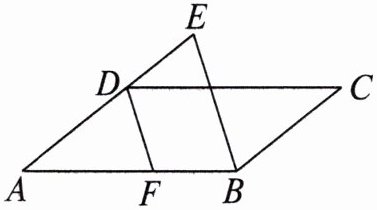
$70^{\circ}$
答案:
【解析】:
- 因为四边形$ABCD$是平行四边形,所以$AB// CD$,根据两直线平行,同旁内角互补,可得$\angle ADC + \angle A = 180^{\circ}$。
- 已知$\angle A = 40^{\circ}$,则$\angle ADC = 180^{\circ}-\angle A = 180^{\circ}- 40^{\circ}=140^{\circ}$。
- 因为$DF$平分$\angle ADC$,所以$\angle ADF=\frac{1}{2}\angle ADC=\frac{1}{2}\times140^{\circ} = 70^{\circ}$。
- 又因为$BE// DF$,根据两直线平行,同位角相等,所以$\angle ABE=\angle AFD$。
- 再根据$AB// CD$,可得$\angle AFD=\angle CDF$(两直线平行,内错角相等),而$\angle ADF = \angle CDF = 70^{\circ}$,所以$\angle ABE = 70^{\circ}$。
【答案】:$70^{\circ}$
- 因为四边形$ABCD$是平行四边形,所以$AB// CD$,根据两直线平行,同旁内角互补,可得$\angle ADC + \angle A = 180^{\circ}$。
- 已知$\angle A = 40^{\circ}$,则$\angle ADC = 180^{\circ}-\angle A = 180^{\circ}- 40^{\circ}=140^{\circ}$。
- 因为$DF$平分$\angle ADC$,所以$\angle ADF=\frac{1}{2}\angle ADC=\frac{1}{2}\times140^{\circ} = 70^{\circ}$。
- 又因为$BE// DF$,根据两直线平行,同位角相等,所以$\angle ABE=\angle AFD$。
- 再根据$AB// CD$,可得$\angle AFD=\angle CDF$(两直线平行,内错角相等),而$\angle ADF = \angle CDF = 70^{\circ}$,所以$\angle ABE = 70^{\circ}$。
【答案】:$70^{\circ}$
查看更多完整答案,请扫码查看

