

 搜索
搜索
6. 如图 17-27,反比例函数$y=\frac {k}{x}(k>0)$的图象与矩形$ABCO$的两边相交于$E$,$F$两点,若$E$是$AB$的中点,$S_{△BEF}=2$,则$k$的值为 (
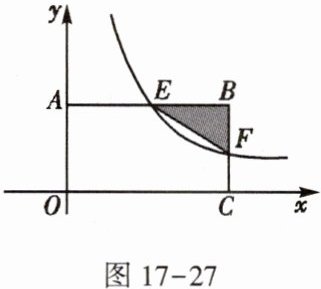
A. 2
B. $\sqrt {5}$
C. $2\sqrt {2}$
D. 8
D
)A. 2
B. $\sqrt {5}$
C. $2\sqrt {2}$
D. 8
答案:
D
1. 已知点$M(a-3,a+2)$在$y$轴上,则$a$的值为____
3
。
答案:
3
2. 若点$P(a,b)$在第四象限,则点$(b,-a)$在第
三
象限。
答案:
三
3. 如果一次函数$y=kx+3$($k$是常数,$k≠0$)的图象经过点$(1,0)$,那么$y$的值随$x$的增大而
减小
。
答案:
减小
4. 如图 17-28,反比例函数$y=\frac {k}{x}(x>0)$经过$A$,$B$两点,过点$A$作$AC⊥y$轴于点$C$,过点$B$作$BD⊥y$轴于点$D$,过点$B$作$BE⊥x$轴于点$E$,连接$AD$,已知$AC=1$,$BE=1$,矩形$BDOE$的面积为$4$,则$△ACD$的面积为
$\frac{3}{2}$
。
答案:
$\frac{3}{2}$ 提示:连接 $AO$,由反比例函数 $k$ 的几何意义,可知 $S_{\triangle AOC}=\frac{1}{2}S_{矩形BDOE}=2$。$\because AC = 1$,$\therefore CO = 4$。$\because DO = BE = 1$,$\therefore CD = 3$,$\therefore S_{\triangle ACD}=\frac{3}{2}$。
1. 如图 17-29,一次函数$y=mx+b$的图象与反比例函数$y=\frac {k}{x}$的图象交于$A(3,1)$,$B(-\frac {1}{2},n)$两点。
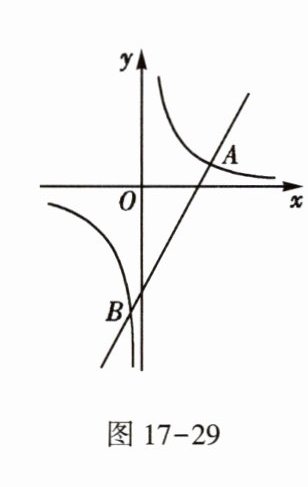
(1) 求该反比例函数的表达式;
(2) 求$n$的值及该一次函数的表达式。
(1)
(2) $n$的值为
(1) 求该反比例函数的表达式;
(2) 求$n$的值及该一次函数的表达式。
(1)
$y=\frac{3}{x}$
(2) $n$的值为
$-6$
,该一次函数的表达式为$y = 2x - 5$
答案:
(1) $\because$ 反比例函数 $y=\frac{k}{x}$ 的图象经过 $A(3,1)$,$\therefore k = 3\times1 = 3$,$\therefore$ 该反比例函数的表达式为 $y=\frac{3}{x}$。
(2) 把 $B(-\frac{1}{2},n)$ 代入反比例函数表达式,可得 $-\frac{1}{2}n = 3$,解得 $n = -6$,$\therefore$ 点 $B$ 的坐标为 $(-\frac{1}{2},-6)$。把 $A(3,1)$,$B(-\frac{1}{2},-6)$ 代入一次函数 $y = mx + b$,得 $\begin{cases}1 = 3m + b,\\-6 = -\frac{1}{2}m + b,\end{cases}$ 解得 $\begin{cases}m = 2,\\b = -5,\end{cases}$ $\therefore$ 一次函数的表达式为 $y = 2x - 5$。
(1) $\because$ 反比例函数 $y=\frac{k}{x}$ 的图象经过 $A(3,1)$,$\therefore k = 3\times1 = 3$,$\therefore$ 该反比例函数的表达式为 $y=\frac{3}{x}$。
(2) 把 $B(-\frac{1}{2},n)$ 代入反比例函数表达式,可得 $-\frac{1}{2}n = 3$,解得 $n = -6$,$\therefore$ 点 $B$ 的坐标为 $(-\frac{1}{2},-6)$。把 $A(3,1)$,$B(-\frac{1}{2},-6)$ 代入一次函数 $y = mx + b$,得 $\begin{cases}1 = 3m + b,\\-6 = -\frac{1}{2}m + b,\end{cases}$ 解得 $\begin{cases}m = 2,\\b = -5,\end{cases}$ $\therefore$ 一次函数的表达式为 $y = 2x - 5$。
2. 如图 17-30,已知过点$B(1,0)$的直线$l_{1}$与直线$l_{2}:y=2x+4$相交于点$P(-1,a)$。
(1) 求直线$l_{1}$的函数表达式;
(2) 求四边形$PAOC$的面积。

(1) 求直线$l_{1}$的函数表达式;
$y = -x + 1$
(2) 求四边形$PAOC$的面积。
$\frac{5}{2}$
答案:
(1) $\because$ 点 $P(-1,a)$ 在直线 $l_2:y = 2x + 4$ 上,$\therefore 2\times(-1) + 4 = a$,$\therefore a = 2$,$\therefore$ 点 $P$ 的坐标为 $(-1,2)$。设直线 $l_1$ 的函数表达式为 $y = kx + b(k\neq0)$,由直线 $l_1$ 过点 $B(1,0)$ 和 $P(-1,a)$,则 $\begin{cases}k + b = 0,\\-k + b = 2.\end{cases}$ 解得 $\begin{cases}k = -1,\\b = 1.\end{cases}$ $\therefore$ 直线 $l_1$ 的函数表达式为 $y = -x + 1$。
(2) $\because$ 直线 $l_1$ 与 $y$ 轴相交于点 $C$,$\therefore$ 点 $C$ 的坐标为 $(0,1)$。又 $\because$ 直线 $l_2$ 与 $x$ 轴相交于点 $A$,$\therefore$ 点 $A$ 的坐标为 $(-2,0)$,$\therefore AB = 3$,$\therefore S_{四边形PAOC}=S_{\triangle PAB}-S_{\triangle BOC}=\frac{1}{2}\times3\times2-\frac{1}{2}\times1\times1=\frac{5}{2}$。
(1) $\because$ 点 $P(-1,a)$ 在直线 $l_2:y = 2x + 4$ 上,$\therefore 2\times(-1) + 4 = a$,$\therefore a = 2$,$\therefore$ 点 $P$ 的坐标为 $(-1,2)$。设直线 $l_1$ 的函数表达式为 $y = kx + b(k\neq0)$,由直线 $l_1$ 过点 $B(1,0)$ 和 $P(-1,a)$,则 $\begin{cases}k + b = 0,\\-k + b = 2.\end{cases}$ 解得 $\begin{cases}k = -1,\\b = 1.\end{cases}$ $\therefore$ 直线 $l_1$ 的函数表达式为 $y = -x + 1$。
(2) $\because$ 直线 $l_1$ 与 $y$ 轴相交于点 $C$,$\therefore$ 点 $C$ 的坐标为 $(0,1)$。又 $\because$ 直线 $l_2$ 与 $x$ 轴相交于点 $A$,$\therefore$ 点 $A$ 的坐标为 $(-2,0)$,$\therefore AB = 3$,$\therefore S_{四边形PAOC}=S_{\triangle PAB}-S_{\triangle BOC}=\frac{1}{2}\times3\times2-\frac{1}{2}\times1\times1=\frac{5}{2}$。
查看更多完整答案,请扫码查看

