

 搜索
搜索
第72页
- 第1页
- 第2页
- 第3页
- 第4页
- 第5页
- 第6页
- 第7页
- 第8页
- 第9页
- 第10页
- 第11页
- 第12页
- 第13页
- 第14页
- 第15页
- 第16页
- 第17页
- 第18页
- 第19页
- 第20页
- 第21页
- 第22页
- 第23页
- 第24页
- 第25页
- 第26页
- 第27页
- 第28页
- 第29页
- 第30页
- 第31页
- 第32页
- 第33页
- 第34页
- 第35页
- 第36页
- 第37页
- 第38页
- 第39页
- 第40页
- 第41页
- 第42页
- 第43页
- 第44页
- 第45页
- 第46页
- 第47页
- 第48页
- 第49页
- 第50页
- 第51页
- 第52页
- 第53页
- 第54页
- 第55页
- 第56页
- 第57页
- 第58页
- 第59页
- 第60页
- 第61页
- 第62页
- 第63页
- 第64页
- 第65页
- 第66页
- 第67页
- 第68页
- 第69页
- 第70页
- 第71页
- 第72页
- 第73页
- 第74页
- 第75页
- 第76页
- 第77页
- 第78页
- 第79页
- 第80页
- 第81页
- 第82页
- 第83页
- 第84页
- 第85页
- 第86页
- 第87页
- 第88页
- 第89页
- 第90页
- 第91页
- 第92页
- 第93页
- 第94页
- 第95页
- 第96页
- 第97页
- 第98页
- 第99页
- 第100页
- 第101页
- 第102页
- 第103页
- 第104页
- 第105页
- 第106页
- 第107页
- 第108页
- 第109页
- 第110页
- 第111页
- 第112页
- 第113页
- 第114页
- 第115页
- 第116页
- 第117页
- 第118页
- 第119页
- 第120页
- 第121页
- 第122页
- 第123页
- 第124页
- 第125页
- 第126页
- 第127页
- 第128页
- 第129页
- 第130页
- 第131页
- 第132页
- 第133页
- 第134页
- 第135页
- 第136页
- 第137页
- 第138页
- 第139页
- 第140页
- 第141页
- 第142页
- 第143页
- 第144页
- 第145页
- 第146页
- 第147页
- 第148页
- 第149页
- 第150页
- 第151页
- 第152页
- 第153页
- 第154页
- 第155页
- 第156页
- 第157页
- 第158页
- 第159页
- 第160页
- 第161页
- 第162页
- 第163页
- 第164页
- 第165页
- 第166页
- 第167页
- 第168页
- 第169页
- 第170页
- 第171页
- 第172页
- 第173页
- 第174页
- 第175页
- 第176页
- 第177页
- 第178页
- 第179页
- 第180页
- 第181页
- 第182页
- 第183页
- 第184页
- 第185页
- 第186页
- 第187页
- 第188页
- 第189页
- 第190页
- 第191页
- 第192页
- 第193页
- 第194页
Ⅳ. 阅读理解
跨学科历史 Brad daydreamed throughout a history class and missed an important lesson on the Grand Canal. At night, he found himself stuck when doing his homework on this ancient Chinese project. A moment later, he thought of his Sight Pro, the smart glasses, and put them on.
“Teach me about the Grand Canal.” Before he knew it, this simple instruction took the boy on a journey along the canal. He started in Hangzhou and was now slowly travelling up north towards Yangzhou.
He was taking in the fascinating views on the banks of the canal when Sight Pro suddenly said,
“Are you giving me a quiz? Hmm, bring it on.”
A question appeared before his eyes: “What is the total length of the Grand Canal? Is it more than 1,000 kilometres or 2,000 kilometres?”
“I'll go for 1,000 kilometres.” It took Brad two seconds to decide.
“Wrong answer. The Grand Canal is a system of more than 2,000 kilometres of man-made waterways. It's the longest in the world.”
Then came the next question: “When did the building of the canal begin?”
“Was it in the 7th century?” Brad responded hesitantly.
“Wrong answer. It started in the 5th century BCE. After that, different sections were built at different times. In the 7th century, Emperor Yang of Sui expanded the canal to its present scale (规模) by linking the sections.”
“How amazing!” Brad continued his journey for a while.
Then came the third question: “Why was the Grand Canal built?”
“To make it easier for people to travel around the country.”
“Wrong answer. Its primary function was to transport food from the rich lands in the south to the capital city in the north. It was also used to transport goods.”
In the end, Brad scored zero on all the questions, but he was pleased that he had learned a lot.
“A big change happened to the Grand Canal during the Yuan Dynasty because the capital was moved to Beijing. Emperors needed new routes,” he wrote in response to one question.
“Mega job, Brad!” Sight Pro's sweet voice was heard again.
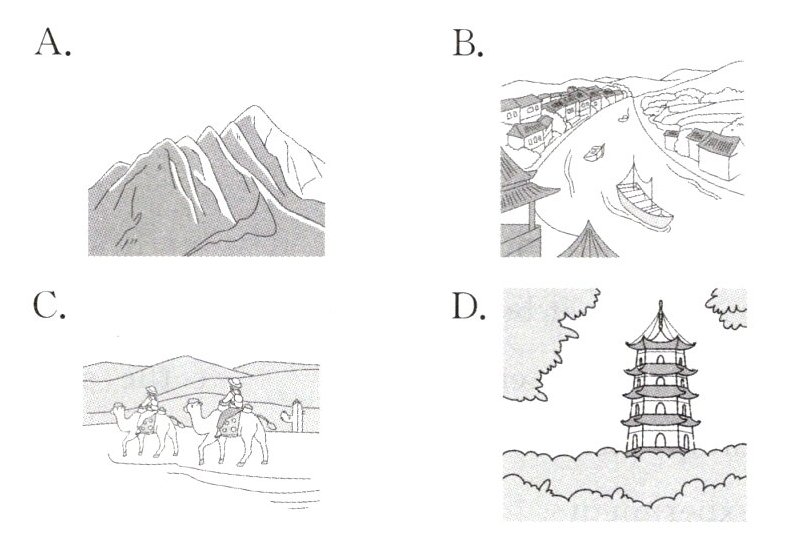
1. 新考法图示理解 Which picture shows the Grand Canal?
A.
B.
C.
D.
2. 新考法补全文章 Which of the following can be put in
A. How do you like your journey?
B. How beautiful the Grand Canal is!
C. Fun time is over. Here comes the hard part.
D. Enjoy it, right? Now it's time to take me off.
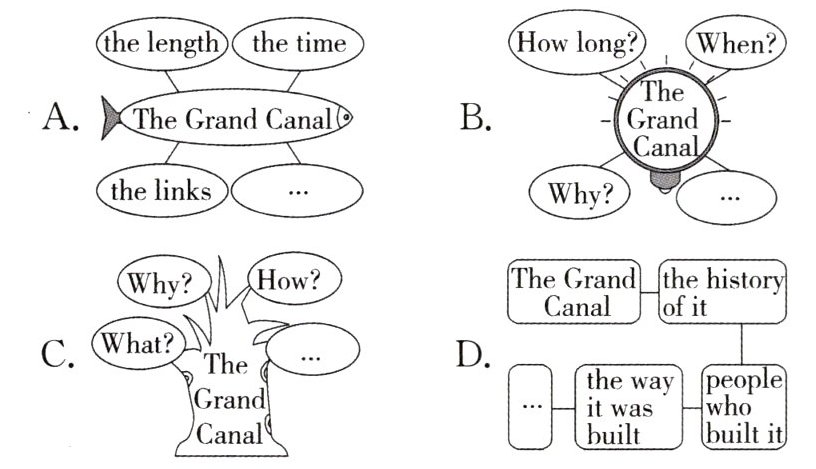
3. 新考法创新设问 Based on which mind map does Sight Pro raise questions?
A.
B.
C.
D.
4. Why was Brad pleased even if he scored zero?
A. Because he enjoyed the process of learning.
B. Because he knew how to do his homework.
C. Because there was no need for him to finish his homework.
D. Because he was very proud of our national heritage.
5. Which might the “one question” be in Para. 16?
A. How was the Grand Canal built?
B. Why was the capital moved to Beijing?
C. How long has the Grand Canal been a World Heritage Site?
D. Why was the Grand Canal changed in the Yuan Dynasty?
跨学科历史 Brad daydreamed throughout a history class and missed an important lesson on the Grand Canal. At night, he found himself stuck when doing his homework on this ancient Chinese project. A moment later, he thought of his Sight Pro, the smart glasses, and put them on.
“Teach me about the Grand Canal.” Before he knew it, this simple instruction took the boy on a journey along the canal. He started in Hangzhou and was now slowly travelling up north towards Yangzhou.
He was taking in the fascinating views on the banks of the canal when Sight Pro suddenly said,
“Are you giving me a quiz? Hmm, bring it on.”
A question appeared before his eyes: “What is the total length of the Grand Canal? Is it more than 1,000 kilometres or 2,000 kilometres?”
“I'll go for 1,000 kilometres.” It took Brad two seconds to decide.
“Wrong answer. The Grand Canal is a system of more than 2,000 kilometres of man-made waterways. It's the longest in the world.”
Then came the next question: “When did the building of the canal begin?”
“Was it in the 7th century?” Brad responded hesitantly.
“Wrong answer. It started in the 5th century BCE. After that, different sections were built at different times. In the 7th century, Emperor Yang of Sui expanded the canal to its present scale (规模) by linking the sections.”
“How amazing!” Brad continued his journey for a while.
Then came the third question: “Why was the Grand Canal built?”
“To make it easier for people to travel around the country.”
“Wrong answer. Its primary function was to transport food from the rich lands in the south to the capital city in the north. It was also used to transport goods.”
In the end, Brad scored zero on all the questions, but he was pleased that he had learned a lot.
“A big change happened to the Grand Canal during the Yuan Dynasty because the capital was moved to Beijing. Emperors needed new routes,” he wrote in response to one question.
“Mega job, Brad!” Sight Pro's sweet voice was heard again.
1. 新考法图示理解 Which picture shows the Grand Canal?
A.
B.
C.
D.
2. 新考法补全文章 Which of the following can be put in
A. How do you like your journey?
B. How beautiful the Grand Canal is!
C. Fun time is over. Here comes the hard part.
D. Enjoy it, right? Now it's time to take me off.
3. 新考法创新设问 Based on which mind map does Sight Pro raise questions?
A.
B.
C.
D.
4. Why was Brad pleased even if he scored zero?
A. Because he enjoyed the process of learning.
B. Because he knew how to do his homework.
C. Because there was no need for him to finish his homework.
D. Because he was very proud of our national heritage.
5. Which might the “one question” be in Para. 16?
A. How was the Grand Canal built?
B. Why was the capital moved to Beijing?
C. How long has the Grand Canal been a World Heritage Site?
D. Why was the Grand Canal changed in the Yuan Dynasty?
答案:
1 - 5 BCBAD
【语篇解读】本文是一篇记叙文。文章主要讲述了 Brad 在历史课上走神,晚上借助智能眼镜 Sight Pro 学习大运河知识的故事。
1. B 图示理解题。根据第二段“He started in Hangzhou and was now slowly travelling up north towards Yangzhou.”和常识可知,他从杭州出发,慢慢北上扬州,据此可知,大运河是中国南北走向的人工运河系统;选项 B 图片内容符合题意。故选 B。
2. C 补全文章题。根据上文“He was taking in the fascinating views on the banks of the canal when Sight Pro suddenly said”可知,Brad 借助 Sight Pro 在大运河上虚拟旅行欣赏风景,后文开始出现关于大运河的问题测试;选项 C“欢乐时光结束,困难部分来了。”自然地从欣赏风景过渡到知识测试,符合语境。故选 C。
3. B 推理判断题。问题围绕大运河的基本信息展开,如长度(What is the total length of the Grand Canal?)、建造时间(When did the building of the canal begin?)以及建造目的(Why was the Grand Canal built?)等;选项 B 思维导图符合题意。故选 B。
4. A 推理判断题。根据倒数第三段“but he was pleased that he had learned a lot”可知,Brad 虽答题得零分,但在借助 Sight Pro 旅行过程中学习到很多知识,享受了这个过程。故选 A。
5. D 细节理解题。根据第十六段“‘A big change happened to the Grand Canal during the Yuan Dynasty because the capital was moved to Beijing. Emperors needed new routes,’ he wrote in response to one question.”可知,这个问题是关于大运河在元朝发生变化的原因;选项 D“为什么大运河在元朝发生变化?”符合语境。故选 D。
【语篇解读】本文是一篇记叙文。文章主要讲述了 Brad 在历史课上走神,晚上借助智能眼镜 Sight Pro 学习大运河知识的故事。
1. B 图示理解题。根据第二段“He started in Hangzhou and was now slowly travelling up north towards Yangzhou.”和常识可知,他从杭州出发,慢慢北上扬州,据此可知,大运河是中国南北走向的人工运河系统;选项 B 图片内容符合题意。故选 B。
2. C 补全文章题。根据上文“He was taking in the fascinating views on the banks of the canal when Sight Pro suddenly said”可知,Brad 借助 Sight Pro 在大运河上虚拟旅行欣赏风景,后文开始出现关于大运河的问题测试;选项 C“欢乐时光结束,困难部分来了。”自然地从欣赏风景过渡到知识测试,符合语境。故选 C。
3. B 推理判断题。问题围绕大运河的基本信息展开,如长度(What is the total length of the Grand Canal?)、建造时间(When did the building of the canal begin?)以及建造目的(Why was the Grand Canal built?)等;选项 B 思维导图符合题意。故选 B。
4. A 推理判断题。根据倒数第三段“but he was pleased that he had learned a lot”可知,Brad 虽答题得零分,但在借助 Sight Pro 旅行过程中学习到很多知识,享受了这个过程。故选 A。
5. D 细节理解题。根据第十六段“‘A big change happened to the Grand Canal during the Yuan Dynasty because the capital was moved to Beijing. Emperors needed new routes,’ he wrote in response to one question.”可知,这个问题是关于大运河在元朝发生变化的原因;选项 D“为什么大运河在元朝发生变化?”符合语境。故选 D。
查看更多完整答案,请扫码查看

