

 搜索
搜索
第67页
- 第1页
- 第2页
- 第3页
- 第4页
- 第5页
- 第6页
- 第7页
- 第8页
- 第9页
- 第10页
- 第11页
- 第12页
- 第13页
- 第14页
- 第15页
- 第16页
- 第17页
- 第18页
- 第19页
- 第20页
- 第21页
- 第22页
- 第23页
- 第24页
- 第25页
- 第26页
- 第27页
- 第28页
- 第29页
- 第30页
- 第31页
- 第32页
- 第33页
- 第34页
- 第35页
- 第36页
- 第37页
- 第38页
- 第39页
- 第40页
- 第41页
- 第42页
- 第43页
- 第44页
- 第45页
- 第46页
- 第47页
- 第48页
- 第49页
- 第50页
- 第51页
- 第52页
- 第53页
- 第54页
- 第55页
- 第56页
- 第57页
- 第58页
- 第59页
- 第60页
- 第61页
- 第62页
- 第63页
- 第64页
- 第65页
- 第66页
- 第67页
- 第68页
- 第69页
- 第70页
- 第71页
- 第72页
- 第73页
- 第74页
- 第75页
- 第76页
- 第77页
- 第78页
- 第79页
- 第80页
- 第81页
- 第82页
- 第83页
- 第84页
- 第85页
- 第86页
- 第87页
- 第88页
- 第89页
- 第90页
- 第91页
- 第92页
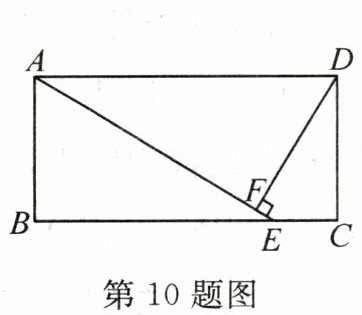
10. 如图,在矩形 ABCD 中,E 为边 BC 上的一点,$DF⊥AE$于点 F,且$AB= 6,AD= 12,AE= 10$,则 DF 的长为 (
A. 5
B. $\frac {11}{3}$
C. $\frac {36}{5}$
D. 8
C
)A. 5
B. $\frac {11}{3}$
C. $\frac {36}{5}$
D. 8
答案:
C
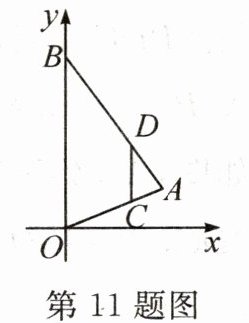
11. 如图,在平面直角坐标系中,C 为$△AOB$的边 OA 上一点,$AC:OC= 1:2$,过点 C 作$CD// OB$交 AB 于点 D. 若 C,D 两点的纵坐标分别为 1,3,则点 B 的纵坐标为 (
A. 4
B. 5
C. 6
D. 7
C
)A. 4
B. 5
C. 6
D. 7
答案:
C
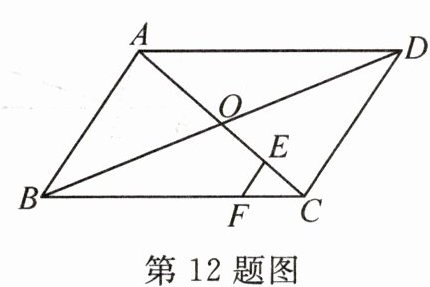
12. (2024·河南)如图,在$□ ABCD$中,对角线 AC,BD 相交于点 O,E 为 OC 的中点,$EF// AB$交 BC 于点 F. 若$AB= 4$,则 EF 的长为 (
A. $\frac {1}{2}$
B. 1
C. $\frac {4}{3}$
D. 2
B
)A. $\frac {1}{2}$
B. 1
C. $\frac {4}{3}$
D. 2
答案:
B
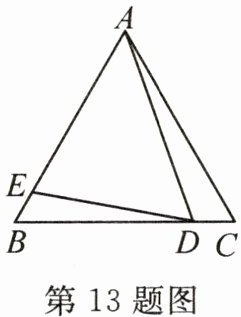
13. (2023·东营改编)如图,$△ABC$为等边三角形,点 D,E 分别在边 BC,AB 上,$∠ADE= 60^{\circ }$.若$BD= 4DC,DE= 2.4$,则 AD 的长为____
3
.
答案:
3
14. 如图,在平行四边形 ABCD 中,过点 A 作$AE⊥BC$,垂足为 E,连接 DE,F 为线段 DE 上一点,且$∠AFE= ∠B$.
(1)求证:$△ADF\backsim △DEC$.
证明:∵四边形 ABCD 是平行四边形,$\therefore AB// CD,AD$ $// BC.\therefore ∠B+∠C=180^{\circ },∠ADF=∠DEC.\because ∠AFD+$ $∠AFE=180^{\circ },∠AFE=∠B,\therefore ∠AFD=∠C.\therefore △ADF\backsim $ $△DEC$.
(2)若$AB= 4,AD= 3\sqrt {3},AF= 2\sqrt {3}$,求 AE 的长.
解:∵四边形 ABCD 是平行四边形,$\therefore CD=AB=4.$ 由(1)知,$△ADF\backsim △DEC,\therefore \frac {AD}{DE}=\frac {AF}{CD}.\therefore DE=\frac {AD\cdot CD}{AF}=$ $\frac {3\sqrt {3}×4}{2\sqrt {3}}=6$. 在$Rt△ADE$中,由勾股定理,得$AE=$ $\sqrt {DE^{2}-AD^{2}}=\sqrt {6^{2}-(3\sqrt {3})^{2}}=$
(1)求证:$△ADF\backsim △DEC$.
证明:∵四边形 ABCD 是平行四边形,$\therefore AB// CD,AD$ $// BC.\therefore ∠B+∠C=180^{\circ },∠ADF=∠DEC.\because ∠AFD+$ $∠AFE=180^{\circ },∠AFE=∠B,\therefore ∠AFD=∠C.\therefore △ADF\backsim $ $△DEC$.
(2)若$AB= 4,AD= 3\sqrt {3},AF= 2\sqrt {3}$,求 AE 的长.
解:∵四边形 ABCD 是平行四边形,$\therefore CD=AB=4.$ 由(1)知,$△ADF\backsim △DEC,\therefore \frac {AD}{DE}=\frac {AF}{CD}.\therefore DE=\frac {AD\cdot CD}{AF}=$ $\frac {3\sqrt {3}×4}{2\sqrt {3}}=6$. 在$Rt△ADE$中,由勾股定理,得$AE=$ $\sqrt {DE^{2}-AD^{2}}=\sqrt {6^{2}-(3\sqrt {3})^{2}}=$
3
.
答案:
解:
(1)证明:
∵四边形 ABCD 是平行四边形,$\therefore AB// CD,AD$ $// BC.\therefore ∠B+∠C=180^{\circ },∠ADF=∠DEC.\because ∠AFD+$ $∠AFE=180^{\circ },∠AFE=∠B,\therefore ∠AFD=∠C.\therefore △ADF\backsim $ $△DEC$.
(2)
∵四边形 ABCD 是平行四边形,$\therefore CD=AB=4.$ 由
(1)知,$△ADF\backsim △DEC,\therefore \frac {AD}{DE}=\frac {AF}{CD}.\therefore DE=\frac {AD\cdot CD}{AF}=$ $\frac {3\sqrt {3}×4}{2\sqrt {3}}=6$. 在$Rt△ADE$中,由勾股定理,得$AE=$ $\sqrt {DE^{2}-AD^{2}}=\sqrt {6^{2}-(3\sqrt {3})^{2}}=3.$
(1)证明:
∵四边形 ABCD 是平行四边形,$\therefore AB// CD,AD$ $// BC.\therefore ∠B+∠C=180^{\circ },∠ADF=∠DEC.\because ∠AFD+$ $∠AFE=180^{\circ },∠AFE=∠B,\therefore ∠AFD=∠C.\therefore △ADF\backsim $ $△DEC$.
(2)
∵四边形 ABCD 是平行四边形,$\therefore CD=AB=4.$ 由
(1)知,$△ADF\backsim △DEC,\therefore \frac {AD}{DE}=\frac {AF}{CD}.\therefore DE=\frac {AD\cdot CD}{AF}=$ $\frac {3\sqrt {3}×4}{2\sqrt {3}}=6$. 在$Rt△ADE$中,由勾股定理,得$AE=$ $\sqrt {DE^{2}-AD^{2}}=\sqrt {6^{2}-(3\sqrt {3})^{2}}=3.$
15. 如图,$∠ABC= 45^{\circ }$,P 为$△ABC$内一点,连接 PA,PB,PC. 已知$∠BPA= ∠BPC= 135^{\circ }$.
(1)求证:$△CPB\backsim △BPA$.
(2)若$AC⊥BC$,试求$\frac {AC}{PC}$的值.
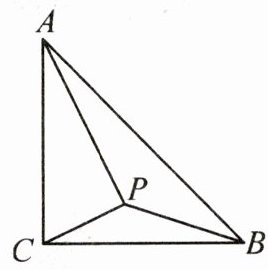
(1)求证:$△CPB\backsim △BPA$.
(2)若$AC⊥BC$,试求$\frac {AC}{PC}$的值.
$\sqrt{5}$
答案:
解:
(1)证明:$\because ∠BPA=135^{\circ },\therefore ∠ABP+∠BAP=180^{\circ }-$ $135^{\circ }=45^{\circ }.\because ∠ABP+∠CBP=∠ABC=45^{\circ },\therefore ∠ABP+$ $∠BAP=∠ABP+∠CBP.\therefore ∠CBP=∠BAP.\because ∠CPB=$ $∠BPA=135^{\circ },\therefore △CPB\backsim △BPA$.
(2)$\because AC⊥BC,∠ABC=$ $45^{\circ },\therefore △ABC$是等腰直角三角形.$\therefore AB=\sqrt {2}BC.\because △CPB\backsim $ $△BPA,\therefore \frac {PC}{PB}=\frac {BP}{AP}=\frac {BC}{AB}=\frac {BC}{\sqrt {2}BC}=\frac {1}{\sqrt {2}}$. 设$PC=a$,则$BP=$ $\sqrt {2}a,AP=2a.\because ∠APC=360^{\circ }-135^{\circ }-135^{\circ }=90^{\circ },\therefore AC=$ $\sqrt {AP^{2}+PC^{2}}=\sqrt {(2a)^{2}+a^{2}}=\sqrt {5}a.\therefore \frac {AC}{PC}=\frac {\sqrt {5}a}{a}=\sqrt {5}.$
(1)证明:$\because ∠BPA=135^{\circ },\therefore ∠ABP+∠BAP=180^{\circ }-$ $135^{\circ }=45^{\circ }.\because ∠ABP+∠CBP=∠ABC=45^{\circ },\therefore ∠ABP+$ $∠BAP=∠ABP+∠CBP.\therefore ∠CBP=∠BAP.\because ∠CPB=$ $∠BPA=135^{\circ },\therefore △CPB\backsim △BPA$.
(2)$\because AC⊥BC,∠ABC=$ $45^{\circ },\therefore △ABC$是等腰直角三角形.$\therefore AB=\sqrt {2}BC.\because △CPB\backsim $ $△BPA,\therefore \frac {PC}{PB}=\frac {BP}{AP}=\frac {BC}{AB}=\frac {BC}{\sqrt {2}BC}=\frac {1}{\sqrt {2}}$. 设$PC=a$,则$BP=$ $\sqrt {2}a,AP=2a.\because ∠APC=360^{\circ }-135^{\circ }-135^{\circ }=90^{\circ },\therefore AC=$ $\sqrt {AP^{2}+PC^{2}}=\sqrt {(2a)^{2}+a^{2}}=\sqrt {5}a.\therefore \frac {AC}{PC}=\frac {\sqrt {5}a}{a}=\sqrt {5}.$
查看更多完整答案,请扫码查看

