

 搜索
搜索
2025年高考帮数学
注:目前有些书本章节名称可能整理的还不是很完善,但都是按照顺序排列的,请同学们按照顺序仔细查找。练习册 2025年高考帮数学 答案主要是用来给同学们做完题方便对答案用的,请勿直接抄袭。
第115页
- 第1页
- 第2页
- 第3页
- 第4页
- 第5页
- 第6页
- 第7页
- 第8页
- 第9页
- 第10页
- 第11页
- 第12页
- 第13页
- 第14页
- 第15页
- 第16页
- 第17页
- 第18页
- 第19页
- 第20页
- 第21页
- 第22页
- 第23页
- 第24页
- 第25页
- 第26页
- 第27页
- 第28页
- 第29页
- 第30页
- 第31页
- 第32页
- 第33页
- 第34页
- 第35页
- 第36页
- 第37页
- 第38页
- 第39页
- 第40页
- 第41页
- 第42页
- 第43页
- 第44页
- 第45页
- 第46页
- 第47页
- 第48页
- 第49页
- 第50页
- 第51页
- 第52页
- 第53页
- 第54页
- 第55页
- 第56页
- 第57页
- 第58页
- 第59页
- 第60页
- 第61页
- 第62页
- 第63页
- 第64页
- 第65页
- 第66页
- 第67页
- 第68页
- 第69页
- 第70页
- 第71页
- 第72页
- 第73页
- 第74页
- 第75页
- 第76页
- 第77页
- 第78页
- 第79页
- 第80页
- 第81页
- 第82页
- 第83页
- 第84页
- 第85页
- 第86页
- 第87页
- 第88页
- 第89页
- 第90页
- 第91页
- 第92页
- 第93页
- 第94页
- 第95页
- 第96页
- 第97页
- 第98页
- 第99页
- 第100页
- 第101页
- 第102页
- 第103页
- 第104页
- 第105页
- 第106页
- 第107页
- 第108页
- 第109页
- 第110页
- 第111页
- 第112页
- 第113页
- 第114页
- 第115页
- 第116页
- 第117页
- 第118页
- 第119页
- 第120页
- 第121页
- 第122页
- 第123页
- 第124页
- 第125页
- 第126页
- 第127页
- 第128页
- 第129页
- 第130页
- 第131页
- 第132页
- 第133页
- 第134页
- 第135页
- 第136页
- 第137页
- 第138页
- 第139页
- 第140页
- 第141页
- 第142页
- 第143页
- 第144页
- 第145页
- 第146页
- 第147页
- 第148页
- 第149页
- 第150页
- 第151页
- 第152页
- 第153页
- 第154页
- 第155页
- 第156页
- 第157页
- 第158页
- 第159页
- 第160页
- 第161页
- 第162页
- 第163页
- 第164页
- 第165页
- 第166页
- 第167页
- 第168页
- 第169页
- 第170页
- 第171页
- 第172页
- 第173页
- 第174页
- 第175页
- 第176页
- 第177页
- 第178页
- 第179页
- 第180页
- 第181页
- 第182页
- 第183页
- 第184页
- 第185页
- 第186页
- 第187页
- 第188页
- 第189页
- 第190页
- 第191页
- 第192页
- 第193页
- 第194页
- 第195页
- 第196页
- 第197页
- 第198页
- 第199页
- 第200页
- 第201页
- 第202页
- 第203页
- 第204页
- 第205页
- 第206页
- 第207页
例6 [全国卷Ⅲ]在矩形ABCD中,AB = 1,AD = 2,动点P在以点C为圆心且与BD相切的圆上.若$\overrightarrow{AP}=\lambda\overrightarrow{AB}+\mu\overrightarrow{AD}$,则$\lambda+\mu$的最大值为 ( )
A. 3
B. $2\sqrt{2}$
C. $\sqrt{5}$
D. 2
A. 3
B. $2\sqrt{2}$
C. $\sqrt{5}$
D. 2
答案:
思维帮
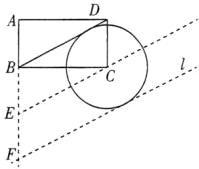
例6A解法一如图,过点C作CE//BD交直线AB于点E,因为$\overrightarrow{AP}=\lambda\overrightarrow{AB}+\mu\overrightarrow{AD}$,则由等和线定理可知,当等和线l与圆相切时,$\lambda+\mu$最大,设此时l与直线AB交于点F,则易知AB = BE = EF,此时$\lambda+\mu=\frac{AF}{AB}=\frac{AB + BE + EF}{AB}=\frac{3AB}{AB}=3$.
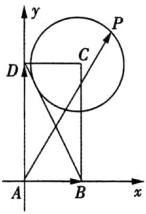
解法二以A为坐标原点,AB,AD所在直线分别为x轴、y轴建立如图所示的平面直角坐标系,则A(0,0),B(1,0),C(1,2),D(0,2).可得直线BD的方程为2x + y - 2 = 0,点C到直线BD的距离$d=\frac{2}{\sqrt{2^{2}+1^{2}}}=\frac{2}{\sqrt{5}}$,所以圆C的方程为$(x - 1)^{2}+(y - 2)^{2}=\frac{4}{5}$.因为点P在圆C上,所以可设$P(1+\frac{2\sqrt{5}}{5}\cos\theta,2+\frac{2\sqrt{5}}{5}\sin\theta)$.易知$\overrightarrow{AB}=(1,0)$,$\overrightarrow{AD}=(0,2)$,$\overrightarrow{AP}=\lambda\overrightarrow{AB}+\mu\overrightarrow{AD}=(\lambda,2\mu)$,所以$\begin{cases}1+\frac{2\sqrt{5}}{5}\cos\theta=\lambda\\2+\frac{2\sqrt{5}}{5}\sin\theta = 2\mu\end{cases}$,所以$\lambda+\mu=2+\frac{2\sqrt{5}}{5}\cos\theta+\frac{\sqrt{5}}{5}\sin\theta=2+\sin(\theta+\varphi)\leq3$,其中$\varphi$满足$\tan\varphi = 2$.所以$\lambda+\mu$的最大值为3.
思维帮
例6A解法一如图,过点C作CE//BD交直线AB于点E,因为$\overrightarrow{AP}=\lambda\overrightarrow{AB}+\mu\overrightarrow{AD}$,则由等和线定理可知,当等和线l与圆相切时,$\lambda+\mu$最大,设此时l与直线AB交于点F,则易知AB = BE = EF,此时$\lambda+\mu=\frac{AF}{AB}=\frac{AB + BE + EF}{AB}=\frac{3AB}{AB}=3$.
解法二以A为坐标原点,AB,AD所在直线分别为x轴、y轴建立如图所示的平面直角坐标系,则A(0,0),B(1,0),C(1,2),D(0,2).可得直线BD的方程为2x + y - 2 = 0,点C到直线BD的距离$d=\frac{2}{\sqrt{2^{2}+1^{2}}}=\frac{2}{\sqrt{5}}$,所以圆C的方程为$(x - 1)^{2}+(y - 2)^{2}=\frac{4}{5}$.因为点P在圆C上,所以可设$P(1+\frac{2\sqrt{5}}{5}\cos\theta,2+\frac{2\sqrt{5}}{5}\sin\theta)$.易知$\overrightarrow{AB}=(1,0)$,$\overrightarrow{AD}=(0,2)$,$\overrightarrow{AP}=\lambda\overrightarrow{AB}+\mu\overrightarrow{AD}=(\lambda,2\mu)$,所以$\begin{cases}1+\frac{2\sqrt{5}}{5}\cos\theta=\lambda\\2+\frac{2\sqrt{5}}{5}\sin\theta = 2\mu\end{cases}$,所以$\lambda+\mu=2+\frac{2\sqrt{5}}{5}\cos\theta+\frac{\sqrt{5}}{5}\sin\theta=2+\sin(\theta+\varphi)\leq3$,其中$\varphi$满足$\tan\varphi = 2$.所以$\lambda+\mu$的最大值为3.
训练4 在扇形AOB中,C为弧AB上的一个动点,$\angle AOB = 60^{\circ}$.若$\overrightarrow{OC}=x\overrightarrow{OA}+y\overrightarrow{OB}$,则x + 3y的取值范围是________.
答案:
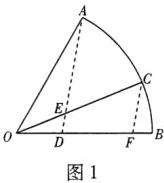
训练4[1,3] 解法一 如图1,在OB上取一点D,使OB = 3OD,连接AD,与OC交于点E,过C作CF//AD,交OB于点F,则$\overrightarrow{OC}=x\overrightarrow{OA}+y\overrightarrow{OB}=x\overrightarrow{OA}+3y\overrightarrow{OD}$,所以$x + 3y=\frac{OC}{OE}=\frac{OF}{OD}$.当C,A重合时,$\frac{OF}{OD}$最小,为1;当C,B重合时,$\frac{OF}{OD}$最大,为3,所以x + 3y的取值范围是[1,3].
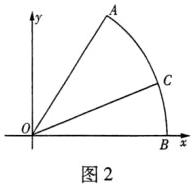
解法二(坐标法)设扇形AOB的半径为1,以O为原点,建立如图2所示的平面直角坐标系,则B(1,0),$A(\frac{1}{2},\frac{\sqrt{3}}{2})$,设$\angle BOC=\theta$,$0\leq\theta\leq\frac{\pi}{3}$,则C($\cos\theta,\sin\theta$),$\overrightarrow{OC}=(\cos\theta,\sin\theta)=x(\frac{1}{2},\frac{\sqrt{3}}{2})+y(1,0)$,即$\begin{cases}\cos\theta=\frac{x}{2}+y\\\sin\theta=\frac{\sqrt{3}}{2}x\end{cases}$,解得$\begin{cases}x=\frac{2\sqrt{3}\sin\theta}{3}\\y=\cos\theta-\frac{\sqrt{3}\sin\theta}{3}\end{cases}$,所以$x + 3y=\frac{2\sqrt{3}\sin\theta}{3}+3\cos\theta-\sqrt{3}\sin\theta=3\cos\theta-\frac{\sqrt{3}}{3}\sin\theta$.令$g(\theta)=3\cos\theta-\frac{\sqrt{3}}{3}\sin\theta(0\leq\theta\leq\frac{\pi}{3})$,易知$g(\theta)$在$[0,\frac{\pi}{3}]$上单调递减,所以$g(\frac{\pi}{3}) = 1\leq g(\theta)\leq g(0)=3$,所以x + 3y的取值范围是[1,3].
解法三(构造函数法) 设扇形AOB的半径为r,因为$\overrightarrow{OC}=x\overrightarrow{OA}+y\overrightarrow{OB}$,所以$\overrightarrow{OC}^{2}=(x\overrightarrow{OA}+y\overrightarrow{OB})^{2}=x^{2}\overrightarrow{OA}^{2}+2xy|\overrightarrow{OA}||\overrightarrow{OB}|\cdot\cos60^{\circ}+y^{2}\overrightarrow{OB}^{2}$,即$r^{2}=x^{2}r^{2}+xyr^{2}+y^{2}r^{2}$,整理得关于y的方程$y^{2}+xy+x^{2}-1 = 0$.易知$x,y\in[0,1]$,$\Delta = 4 - 3x^{2}>0$,所以$y=\frac{-x+\sqrt{4 - 3x^{2}}}{2}$,所以$x + 3y=x+\frac{-3x + 3\sqrt{4 - 3x^{2}}}{2}=-\frac{1}{2}x+\frac{3\sqrt{4 - 3x^{2}}}{2}$.令$f(x)=-\frac{1}{2}x+\frac{3\sqrt{4 - 3x^{2}}}{2}(x\in[0,1])$,易知$f(x)$在[0,1]上单调递减,所以$f(1)=1\leq f(x)\leq f(0)=3$,所以x + 3y的取值范围是[1,3].
训练4[1,3] 解法一 如图1,在OB上取一点D,使OB = 3OD,连接AD,与OC交于点E,过C作CF//AD,交OB于点F,则$\overrightarrow{OC}=x\overrightarrow{OA}+y\overrightarrow{OB}=x\overrightarrow{OA}+3y\overrightarrow{OD}$,所以$x + 3y=\frac{OC}{OE}=\frac{OF}{OD}$.当C,A重合时,$\frac{OF}{OD}$最小,为1;当C,B重合时,$\frac{OF}{OD}$最大,为3,所以x + 3y的取值范围是[1,3].
解法二(坐标法)设扇形AOB的半径为1,以O为原点,建立如图2所示的平面直角坐标系,则B(1,0),$A(\frac{1}{2},\frac{\sqrt{3}}{2})$,设$\angle BOC=\theta$,$0\leq\theta\leq\frac{\pi}{3}$,则C($\cos\theta,\sin\theta$),$\overrightarrow{OC}=(\cos\theta,\sin\theta)=x(\frac{1}{2},\frac{\sqrt{3}}{2})+y(1,0)$,即$\begin{cases}\cos\theta=\frac{x}{2}+y\\\sin\theta=\frac{\sqrt{3}}{2}x\end{cases}$,解得$\begin{cases}x=\frac{2\sqrt{3}\sin\theta}{3}\\y=\cos\theta-\frac{\sqrt{3}\sin\theta}{3}\end{cases}$,所以$x + 3y=\frac{2\sqrt{3}\sin\theta}{3}+3\cos\theta-\sqrt{3}\sin\theta=3\cos\theta-\frac{\sqrt{3}}{3}\sin\theta$.令$g(\theta)=3\cos\theta-\frac{\sqrt{3}}{3}\sin\theta(0\leq\theta\leq\frac{\pi}{3})$,易知$g(\theta)$在$[0,\frac{\pi}{3}]$上单调递减,所以$g(\frac{\pi}{3}) = 1\leq g(\theta)\leq g(0)=3$,所以x + 3y的取值范围是[1,3].
解法三(构造函数法) 设扇形AOB的半径为r,因为$\overrightarrow{OC}=x\overrightarrow{OA}+y\overrightarrow{OB}$,所以$\overrightarrow{OC}^{2}=(x\overrightarrow{OA}+y\overrightarrow{OB})^{2}=x^{2}\overrightarrow{OA}^{2}+2xy|\overrightarrow{OA}||\overrightarrow{OB}|\cdot\cos60^{\circ}+y^{2}\overrightarrow{OB}^{2}$,即$r^{2}=x^{2}r^{2}+xyr^{2}+y^{2}r^{2}$,整理得关于y的方程$y^{2}+xy+x^{2}-1 = 0$.易知$x,y\in[0,1]$,$\Delta = 4 - 3x^{2}>0$,所以$y=\frac{-x+\sqrt{4 - 3x^{2}}}{2}$,所以$x + 3y=x+\frac{-3x + 3\sqrt{4 - 3x^{2}}}{2}=-\frac{1}{2}x+\frac{3\sqrt{4 - 3x^{2}}}{2}$.令$f(x)=-\frac{1}{2}x+\frac{3\sqrt{4 - 3x^{2}}}{2}(x\in[0,1])$,易知$f(x)$在[0,1]上单调递减,所以$f(1)=1\leq f(x)\leq f(0)=3$,所以x + 3y的取值范围是[1,3].
(1)定理:如果$\boldsymbol{e}_{1},\boldsymbol{e}_{2}$是同一平面内的两个①______向量,那么对于这一平面内的任一向量$\boldsymbol{a}$,②_________一对实数$\lambda_{1},\lambda_{2}$,使$\boldsymbol{a}=\lambda_{1}\boldsymbol{e}_{1}+\lambda_{2}\boldsymbol{e}_{2}$.
答案:
①不共线 ②有且只有
(2)基底:若$\boldsymbol{e}_{1},\boldsymbol{e}_{2}$③_________,我们把$\{\boldsymbol{e}_{1},\boldsymbol{e}_{2}\}$叫做表示这一平面内所有向量的一个基底.
答案:
③不共线
(1)把一个向量分解为两个④_________的向量,叫做把向量作正交分解.
答案:
④互相垂直
| |坐标表示|
|--|--|
|和(差)|已知$\boldsymbol{a}=(x_{1},y_{1}),\boldsymbol{b}=(x_{2},y_{2})$,则$\boldsymbol{a}+\boldsymbol{b}=$⑤____________,$\boldsymbol{a}-\boldsymbol{b}=$⑥____________.|
|数乘|已知$\boldsymbol{a}=(x_{1},y_{1})$,则$\lambda\boldsymbol{a}=(\lambda x_{1},\lambda y_{1})$,其中$\lambda$是实数.|
|任一向量的坐标|已知$A(x_{1},y_{1}),B(x_{2},y_{2})$,则$\overrightarrow{AB}=$⑦____________.|
|--|--|
|和(差)|已知$\boldsymbol{a}=(x_{1},y_{1}),\boldsymbol{b}=(x_{2},y_{2})$,则$\boldsymbol{a}+\boldsymbol{b}=$⑤____________,$\boldsymbol{a}-\boldsymbol{b}=$⑥____________.|
|数乘|已知$\boldsymbol{a}=(x_{1},y_{1})$,则$\lambda\boldsymbol{a}=(\lambda x_{1},\lambda y_{1})$,其中$\lambda$是实数.|
|任一向量的坐标|已知$A(x_{1},y_{1}),B(x_{2},y_{2})$,则$\overrightarrow{AB}=$⑦____________.|
答案:
⑤$(x_{1}+x_{2},y_{1}+y_{2})$ ⑥$(x_{1}-x_{2},y_{1}-y_{2})$ ⑦$(x_{2}-x_{1},y_{2}-y_{1})$
查看更多完整答案,请扫码查看

