

 搜索
搜索
第15页
- 第1页
- 第2页
- 第3页
- 第4页
- 第5页
- 第6页
- 第7页
- 第8页
- 第9页
- 第10页
- 第11页
- 第12页
- 第13页
- 第14页
- 第15页
- 第16页
- 第17页
- 第18页
- 第19页
- 第20页
- 第21页
- 第22页
- 第23页
- 第24页
- 第25页
- 第26页
- 第27页
- 第28页
- 第29页
- 第30页
- 第31页
- 第32页
- 第33页
- 第34页
- 第35页
- 第36页
- 第37页
- 第38页
- 第39页
- 第40页
- 第41页
- 第42页
- 第43页
- 第44页
- 第45页
- 第46页
- 第47页
- 第48页
- 第49页
- 第50页
- 第51页
- 第52页
- 第53页
- 第54页
- 第55页
- 第56页
- 第57页
- 第58页
- 第59页
- 第60页
- 第61页
- 第62页
- 第63页
- 第64页
- 第65页
- 第66页
- 第67页
- 第68页
- 第69页
- 第70页
- 第71页
- 第72页
- 第73页
- 第74页
- 第75页
- 第76页
- 第77页
- 第78页
- 第79页
- 第80页
- 第81页
- 第82页
- 第83页
- 第84页
- 第85页
- 第86页
- 第87页
- 第88页
- 第89页
- 第90页
- 第91页
- 第92页
- 第93页
- 第94页
- 第95页
- 第96页
- 第97页
- 第98页
- 第99页
- 第100页
- 第101页
- 第102页
- 第103页
- 第104页
- 第105页
- 第106页
- 第107页
- 第108页
- 第109页
- 第110页
- 第111页
- 第112页
- 第113页
- 第114页
- 第115页
- 第116页
- 第117页
- 第118页
- 第119页
- 第120页
- 第121页
- 第122页
- 第123页
- 第124页
- 第125页
- 第126页
- 第127页
- 第128页
- 第129页
- 第130页
- 第131页
- 第132页
- 第133页
- 第134页
- 第135页
- 第136页
- 第137页
- 第138页
- 第139页
- 第140页
- 第141页
主题:思维导图绘制 词数:235 难度:★★★☆☆ 限时:6 min 正确率:___/5
In the 1960s, Tony Buzan invented mind mapping. Mind maps can be used for all kinds of learning. We can fully think through ideas with the help of mind mapping, and connect the topics with our ideas. It works very well for vocabulary if you are going to learn a new language. You can make up your own mind map according to these steps.
Firstly, draw a circle in the center of a piece of paper and write the vocabulary topic such as animals in the middle.
Secondly, brainstorm some word groups for “animals” and think of headings for each one, such as land animals, aquatic (水生的) animals and amphibious animals (两栖动物). And draw a short line from the centre circle to each single word. Add another circle and write the new group word in the middle.
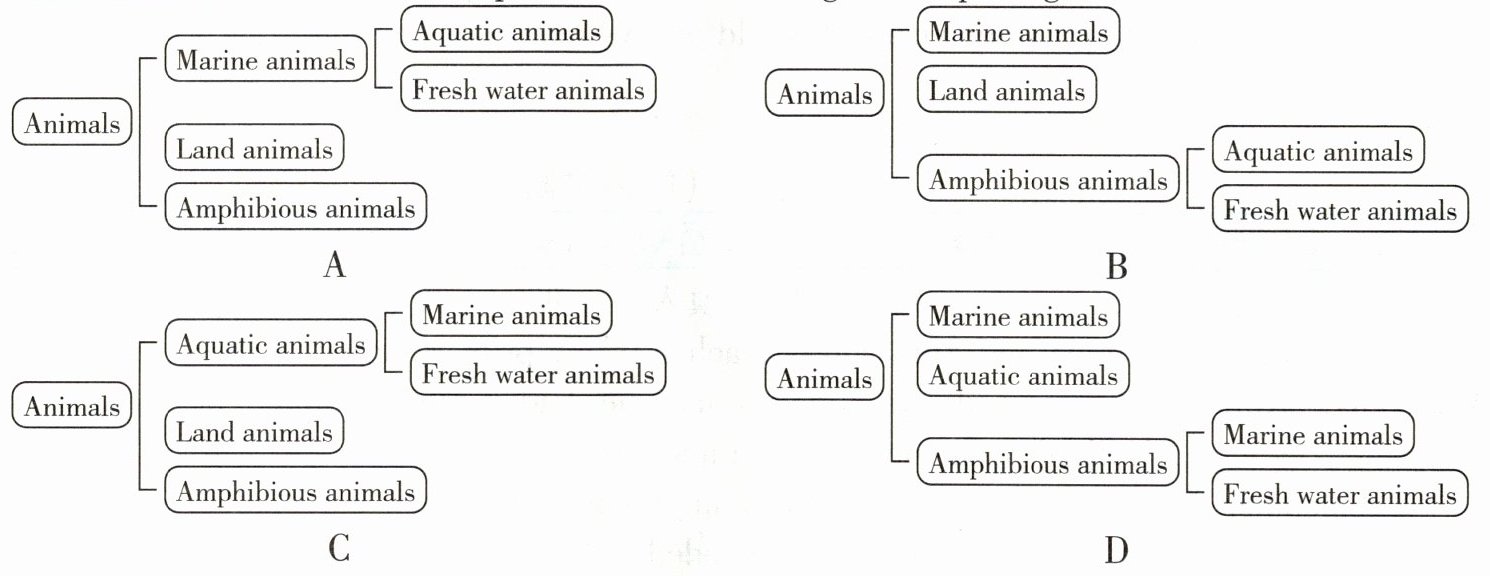
Thirdly, look at each group and try to add more groups. For example, in “aquatic animals”, there are two sub - groups: fresh water animals and marine (海洋的) animals. Draw two more lines, add two more circles and write the two new headings inside them.
When you can’t make any new groups, add a line for each word you know. Write the words along the lines or, if you have enough space, write them inside more circles. As you learn new vocabulary, add it to the mind map. To make a mind map even better, use colors to show important ideas or parts of the map.
( ) 1. When was mind mapping invented?
A. In the 1950s. B. In the 1860s. C. In the 1970s. D. In the 1960s.
( ) 2. What is the first step to make a mind map?
A. Writing the topic. B. Drawing a circle.
C. Adding some lines. D. Writing down some words.
( ) 3. 跨学科知识 Which mind map is correct according to the passage?
( ) 4. How can we make the mind map better?
A. By adding more lines. B. By using different colors.
C. By drawing some pictures. D. By writing down more words.
( ) 5. Where can we read this kind of passage?
A. From a science fiction. B. From a dictionary.
C. From a science magazine. D. From a fashion magazine.
In the 1960s, Tony Buzan invented mind mapping. Mind maps can be used for all kinds of learning. We can fully think through ideas with the help of mind mapping, and connect the topics with our ideas. It works very well for vocabulary if you are going to learn a new language. You can make up your own mind map according to these steps.
Firstly, draw a circle in the center of a piece of paper and write the vocabulary topic such as animals in the middle.
Secondly, brainstorm some word groups for “animals” and think of headings for each one, such as land animals, aquatic (水生的) animals and amphibious animals (两栖动物). And draw a short line from the centre circle to each single word. Add another circle and write the new group word in the middle.
Thirdly, look at each group and try to add more groups. For example, in “aquatic animals”, there are two sub - groups: fresh water animals and marine (海洋的) animals. Draw two more lines, add two more circles and write the two new headings inside them.
When you can’t make any new groups, add a line for each word you know. Write the words along the lines or, if you have enough space, write them inside more circles. As you learn new vocabulary, add it to the mind map. To make a mind map even better, use colors to show important ideas or parts of the map.
( ) 1. When was mind mapping invented?
A. In the 1950s. B. In the 1860s. C. In the 1970s. D. In the 1960s.
( ) 2. What is the first step to make a mind map?
A. Writing the topic. B. Drawing a circle.
C. Adding some lines. D. Writing down some words.
( ) 3. 跨学科知识 Which mind map is correct according to the passage?
( ) 4. How can we make the mind map better?
A. By adding more lines. B. By using different colors.
C. By drawing some pictures. D. By writing down more words.
( ) 5. Where can we read this kind of passage?
A. From a science fiction. B. From a dictionary.
C. From a science magazine. D. From a fashion magazine.
答案:
1. D 细节理解题。根据第一段第一句“In the 1960s, Tony Buzan invented mind mapping.”可知思维导图发明于 20 世纪 60 年代,故选 D。2. B 细节理解题。根据第①点,“Firstly, draw a circle in the center of a piece of paper...”可知绘制思维导图的第一步是在纸中间画个圆圈,故选 B。3. C 细节理解题。由第二、三、四段可知,动物可以划分为陆地生物、水生生物和两栖动物。其中水生动物可分为淡水动物和海洋动物。故选 C。4. B 细节理解题。根据第④点最后一句话可知选 B。5. C 推理判断题。science fiction 科幻小说;dictionary 字典;science magazine 科学杂志;fashion magazine 时尚杂志。根据全文推断,文章教导人们如何绘制思维导图,故我们可以在科学杂志中看到本篇文章,故选 C。
根据提示写出该话题常用的作文金句。
1. 在王老师的帮助下我们相处得很好。(with the help of)
________________
2. 钢笔是用来书写的。(be used for)
________________
1. 在王老师的帮助下我们相处得很好。(with the help of)
________________
2. 钢笔是用来书写的。(be used for)
________________
答案:
1. We get on/along well with each other with the help of Ms./Mr. Wang.
2. Pens are used for writing.
2. Pens are used for writing.
查看更多完整答案,请扫码查看

