

 搜索
搜索
第47页
- 第1页
- 第2页
- 第3页
- 第4页
- 第5页
- 第6页
- 第7页
- 第8页
- 第9页
- 第10页
- 第11页
- 第12页
- 第13页
- 第14页
- 第15页
- 第16页
- 第17页
- 第18页
- 第19页
- 第20页
- 第21页
- 第22页
- 第23页
- 第24页
- 第25页
- 第26页
- 第27页
- 第28页
- 第29页
- 第30页
- 第31页
- 第32页
- 第33页
- 第34页
- 第35页
- 第36页
- 第37页
- 第38页
- 第39页
- 第40页
- 第41页
- 第42页
- 第43页
- 第44页
- 第45页
- 第46页
- 第47页
- 第48页
- 第49页
- 第50页
- 第51页
- 第52页
- 第53页
- 第54页
- 第55页
- 第56页
- 第57页
- 第58页
- 第59页
- 第60页
- 第61页
- 第62页
- 第63页
- 第64页
- 第65页
- 第66页
- 第67页
- 第68页
- 第69页
- 第70页
- 第71页
- 第72页
- 第73页
- 第74页
- 第75页
- 第76页
- 第77页
- 第78页
- 第79页
- 第80页
- 第81页
- 第82页
- 第83页
- 第84页
- 第85页
- 第86页
- 第87页
- 第88页
- 第89页
- 第90页
- 第91页
- 第92页
- 第93页
- 第94页
- 第95页
- 第96页
- 第97页
- 第98页
- 第99页
- 第100页
- 第101页
- 第102页
- 第103页
- 第104页
- 第105页
- 第106页
- 第107页
- 第108页
- 第109页
- 第110页
- 第111页
11.(8分)求下列各式中$x$的值.
(1)$x^{2}-3 = 0$; (2)$(2x - 1)^{2}-169 = 0$; (3)$(3x - 1)^{3}-125 = 0$.
(1)$x^{2}-3 = 0$; (2)$(2x - 1)^{2}-169 = 0$; (3)$(3x - 1)^{3}-125 = 0$.
答案:
(1)$x=\pm\sqrt{3}$
(2)$x=7$或$x=-6$
(3)$x=2$
(1)$x=\pm\sqrt{3}$
(2)$x=7$或$x=-6$
(3)$x=2$
12.(8分)已知实数$a + 9$的平方根是±5,$2b - a$的立方根是-2,求式子$\sqrt{a}-\sqrt{b}$的值.
答案:
解:$\because$实数$a + 9$的平方根是$\pm5$,$2b - a$的立方根是$-2$,
$\therefore a + 9=25$,$2b - a=-8$,解得$a=16$,$b=4$.
$\therefore\sqrt{a}-\sqrt{b}=\sqrt{16}-\sqrt{4}=4 - 2=2$.
$\therefore a + 9=25$,$2b - a=-8$,解得$a=16$,$b=4$.
$\therefore\sqrt{a}-\sqrt{b}=\sqrt{16}-\sqrt{4}=4 - 2=2$.
13.(8分)如图,点$A$表示的数为-$\sqrt{2}$,一只蚂蚁从点$A$沿数轴向右爬2个单位长度后到达点$B$,设点$B$表示的数为$n$.
(1)求$n$的值;
(2)求$\vert n + 1\vert+(n + 2\sqrt{2}-2)$的值.
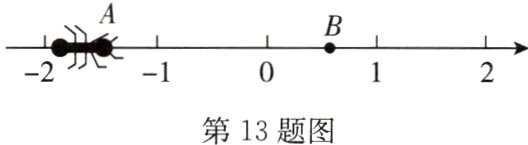
(1)求$n$的值;
(2)求$\vert n + 1\vert+(n + 2\sqrt{2}-2)$的值.
答案:
解:
(1)$\because$蚂蚁从点$A$沿数轴向右爬$2$个单位长度到达点$B$,
$\therefore$点$B$表示的数比点$A$表示的数大$2$.
$\because$点$A$表示的数为$-\sqrt{2}$,点$B$表示的数为$n$,
$\therefore n=-\sqrt{2}+2$.
(2)$|n + 1|+(n + 2\sqrt{2}-2)$
$=|-\sqrt{2}+2+1|+(-\sqrt{2}+2+2\sqrt{2}-2)$
$=3-\sqrt{2}+\sqrt{2}=3$.
(1)$\because$蚂蚁从点$A$沿数轴向右爬$2$个单位长度到达点$B$,
$\therefore$点$B$表示的数比点$A$表示的数大$2$.
$\because$点$A$表示的数为$-\sqrt{2}$,点$B$表示的数为$n$,
$\therefore n=-\sqrt{2}+2$.
(2)$|n + 1|+(n + 2\sqrt{2}-2)$
$=|-\sqrt{2}+2+1|+(-\sqrt{2}+2+2\sqrt{2}-2)$
$=3-\sqrt{2}+\sqrt{2}=3$.
14.(10分)(2023·弋江区期末)某小区有一块面积为$196m^{2}$的正方形空地,开发商计划在此空地上建一个面积为$100m^{2}$的长方形花坛(长方形花坛的边与正方形空地的边平行),使长方形的长是宽的2倍.请你通过计算说明开发商能否实现这个愿望.(参考数据:$\sqrt{2}\approx1.414$,$\sqrt{50}\approx7.071$)
答案:
解:设长方形花坛的宽为$x$m,则长为$2x$m.
由题意得$2x\cdot x=100$,$\therefore x^{2}=50$.
$\because x>0$,
$\therefore x=\sqrt{50}$,$2x=2\sqrt{50}$.
$\because$正方形空地的面积为$196$m²,
$\therefore$正方形空地的边长为$14$m.
$\because 2\sqrt{50}>14$,
$\therefore$开发商不能实现这个愿望.
由题意得$2x\cdot x=100$,$\therefore x^{2}=50$.
$\because x>0$,
$\therefore x=\sqrt{50}$,$2x=2\sqrt{50}$.
$\because$正方形空地的面积为$196$m²,
$\therefore$正方形空地的边长为$14$m.
$\because 2\sqrt{50}>14$,
$\therefore$开发商不能实现这个愿望.
15.(10分)我们知道$a + b = 0$时,$a^{3}+b^{3}=0$也成立,若将$a$看成$a^{3}$的立方根,$b$看成$b^{3}$的立方根,我们能否得出这样的结论:若两个数的立方根互为相反数,则这两个数也互为相反数?
(1)试举一个例子来判断上述猜测结论是否成立;
(2)若$\sqrt[3]{\frac{2x - 1}{7}}$与$\sqrt[3]{-\frac{x - 9}{4}-3}$互为相反数,求$4-\sqrt{x}$的值.
(1)试举一个例子来判断上述猜测结论是否成立;
(2)若$\sqrt[3]{\frac{2x - 1}{7}}$与$\sqrt[3]{-\frac{x - 9}{4}-3}$互为相反数,求$4-\sqrt{x}$的值.
答案:
解:
(1)$2+(-2)=0$,$2^{3}=8$,$(-2)^{3}=-8$,$8+(-8)=0$,
因此结论成立.(举例不唯一)
(2)由
(1)验证的结果可得$\frac{2x - 1}{7}-\frac{x - 9}{4}-3=0$,
去分母,得$4(2x - 1)-7(x - 9)-84=0$,
去括号、移项、合并同类项,得$x=25$.
故$4-\sqrt{x}=4 - 5=-1$.
(1)$2+(-2)=0$,$2^{3}=8$,$(-2)^{3}=-8$,$8+(-8)=0$,
因此结论成立.(举例不唯一)
(2)由
(1)验证的结果可得$\frac{2x - 1}{7}-\frac{x - 9}{4}-3=0$,
去分母,得$4(2x - 1)-7(x - 9)-84=0$,
去括号、移项、合并同类项,得$x=25$.
故$4-\sqrt{x}=4 - 5=-1$.
查看更多完整答案,请扫码查看

