

 搜索
搜索
第13页
- 第1页
- 第2页
- 第3页
- 第4页
- 第5页
- 第6页
- 第7页
- 第8页
- 第9页
- 第10页
- 第11页
- 第12页
- 第13页
- 第14页
- 第15页
- 第16页
- 第17页
- 第18页
- 第19页
- 第20页
- 第21页
- 第22页
- 第23页
- 第24页
- 第25页
- 第26页
- 第27页
- 第28页
- 第29页
- 第30页
- 第31页
- 第32页
- 第33页
- 第34页
- 第35页
- 第36页
- 第37页
- 第38页
- 第39页
- 第40页
- 第41页
- 第42页
- 第43页
- 第44页
- 第45页
- 第46页
- 第47页
- 第48页
- 第49页
- 第50页
- 第51页
- 第52页
- 第53页
- 第54页
- 第55页
- 第56页
- 第57页
- 第58页
- 第59页
- 第60页
- 第61页
- 第62页
- 第63页
- 第64页
- 第65页
- 第66页
- 第67页
- 第68页
- 第69页
- 第70页
- 第71页
- 第72页
- 第73页
- 第74页
- 第75页
- 第76页
- 第77页
- 第78页
- 第79页
- 第80页
一、听录音做调查,完成下列表格,听两遍。
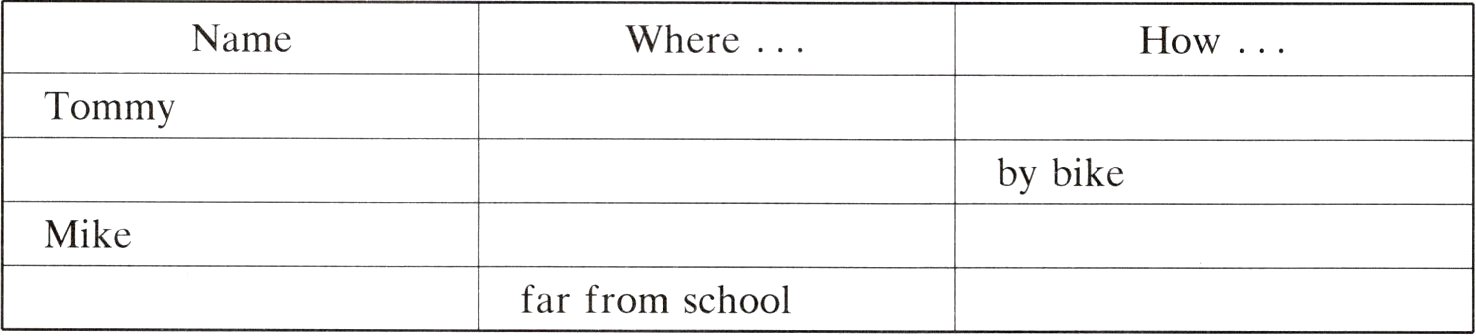
答案:
Name Where... How...
Tommy on Sun Street by metro
Helen on Moon Street by bike
Mike near the school on foot
Liu Tao far from school by car
Tommy on Sun Street by metro
Helen on Moon Street by bike
Mike near the school on foot
Liu Tao far from school by car
二、根据实际情况回答问题。
1. Where do you live?
______________________________
2. Is your home far from your school?
______________________________
3. How do you come to school?
______________________________
4. How does your father go to work?
______________________________
1. Where do you live?
______________________________
2. Is your home far from your school?
______________________________
3. How do you come to school?
______________________________
4. How does your father go to work?
______________________________
答案:
略
三、根据中文提示,完成句子。
1. ——迈克住在哪儿?
——他住在学校附近。
— Where ______ Mike ______?
— He ______ ______ the school.
2. ——他们是怎么来图书馆的?
——他们是坐小汽车来的。
— How ______ they ______ ______ the library?
— They come to the library ______ ______.
3. ——汤姆是坐地铁来公园的吗?
——不,他是走过来的。
— ______ Tom come to the park ______ ______?
— No, he ______. He comes to the park ______ ______.
1. ——迈克住在哪儿?
——他住在学校附近。
— Where ______ Mike ______?
— He ______ ______ the school.
2. ——他们是怎么来图书馆的?
——他们是坐小汽车来的。
— How ______ they ______ ______ the library?
— They come to the library ______ ______.
3. ——汤姆是坐地铁来公园的吗?
——不,他是走过来的。
— ______ Tom come to the park ______ ______?
— No, he ______. He comes to the park ______ ______.
答案:
1. does, live, lives near 2. do, come to, by car 3. Does, by metro, doesn't, on foot
四、阅读短文,判断句子是否与文中意思相符,相符的写T,不符的写F。
When you are in England, you must be very careful (小心的) in the street, because the traffic drives on the left (左边). Before you cross a street, you must look at the right first and then the left. In the morning and in the evening when people go to or come from work, the streets are very busy. Traffic is very dangerous (危险) then. Have a look first, or you will go the wrong way.
In many English cities, there are big buses with two floors. You can sit on the second floor. From there you can see the city very well. It’s very interesting.
( ) 1. The traffic drives on the left in every country.
( ) 2. You must look at the right first and then the left before you cross a street in England.
( ) 3. In England, the traffic is very busy in the afternoon.
( ) 4. We can see big buses with two floors in England.
( ) 5. Sitting on the second floor of the bus, we can see England very well.
When you are in England, you must be very careful (小心的) in the street, because the traffic drives on the left (左边). Before you cross a street, you must look at the right first and then the left. In the morning and in the evening when people go to or come from work, the streets are very busy. Traffic is very dangerous (危险) then. Have a look first, or you will go the wrong way.
In many English cities, there are big buses with two floors. You can sit on the second floor. From there you can see the city very well. It’s very interesting.
( ) 1. The traffic drives on the left in every country.
( ) 2. You must look at the right first and then the left before you cross a street in England.
( ) 3. In England, the traffic is very busy in the afternoon.
( ) 4. We can see big buses with two floors in England.
( ) 5. Sitting on the second floor of the bus, we can see England very well.
答案:
1. F 2. T 3. F 4. T 5. T
查看更多完整答案,请扫码查看

